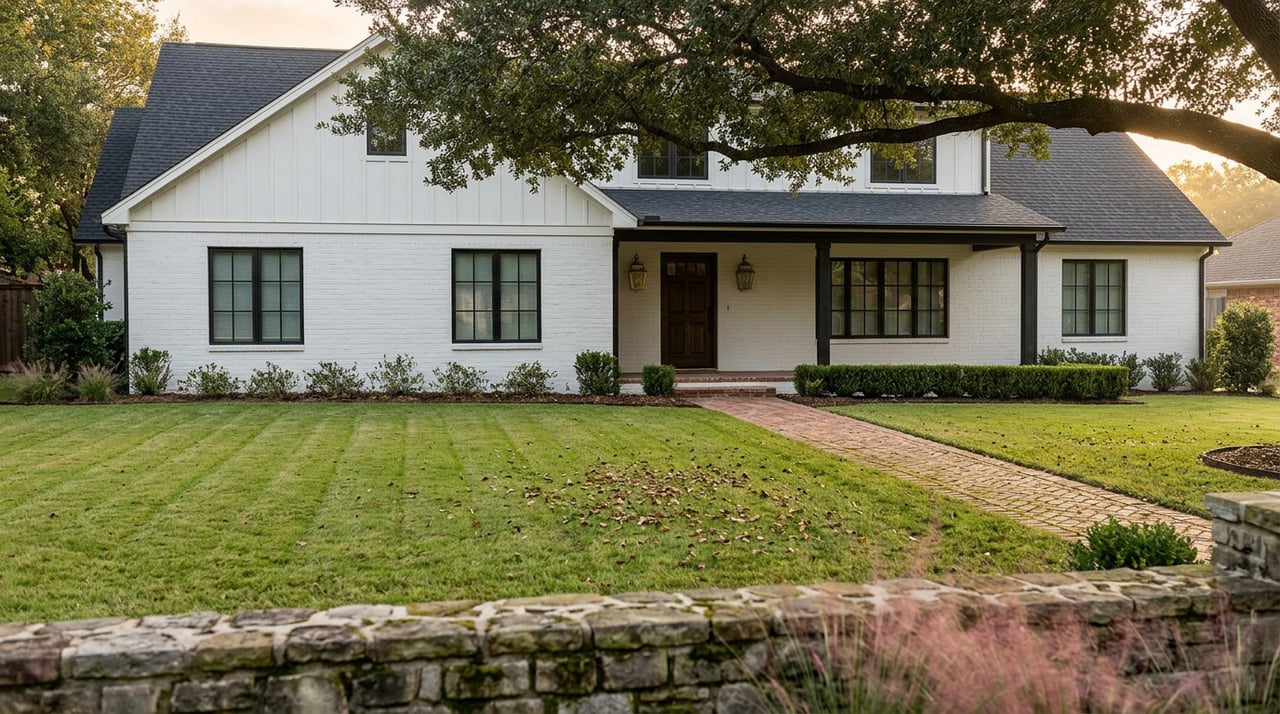
A well-priced, updated home in Lakewood that hits the market today will likely have an offer, often several, before the following Monday. Buyers who show up without a preapproval letter in hand are effectively touring someone else's future kitchen. That single fact of the transaction, more than any headline number, tells you what's actually happening in this East Dallas neighborhood right now.
Here's the puzzle. Across most of Dallas-Fort Worth in 2026, home prices have been flat or drifting down. Regional data compiled from North Texas Real Estate Information System listings put the median single-family price across the metro at $404,900 in July 2026, down 1.7 percent from a year earlier. Inventory has been easing upward. Buyers, in most zip codes, have gained a little leverage.
Lakewood didn't get that memo. Sales data for the neighborhood showed a median price of roughly $1.6 million in early 2026, up around 21 percent year over year, with the trailing twelve-month median climbing 25 percent from the prior period. Price per square foot rose about 15 percent in the same window. That's not a market cooling. That's a market accelerating in the opposite direction of everything around it.
If you're comparing Dallas neighborhoods right now, the temptation is to read that gap as a story about desirability: Lakewood got hotter, other places didn't. The real explanation is less romantic and more useful to know before you make an offer.
The Median Is Measuring Scarcity, Not a Sudden Surge in Popularity
Lakewood is not getting bigger. The neighborhood covers roughly 3,600 homes spread across 61 subdivisions, and there is no undeveloped land left to build on. That number has been essentially fixed for decades. What changed recently is that it got harder to replace what's already there. As Unlocking DFW reports, the Lakewood Conservation District, expanded in 2025, limits teardown-and-rebuild activity on a meaningful share of the neighborhood's housing stock, meaning the usual release valve for tight inventory, knock down an older home and build something bigger, is narrower than it used to be here.
Compare that to a suburb with open land on its edges. When demand rises in a place with room to build, new construction eventually absorbs some of that demand and prices moderate. Lakewood can't do that. When more buyers want in, they're competing for the same 3,600 houses that existed last year, and the year before that. A neighborhood with a hard ceiling on supply behaves less like a typical housing market and more like a fixed pool of shares. Demand up, supply unchanged, price moves fast and moves hard.
That's the mechanism behind the 21 percent jump. It's not that Lakewood suddenly became four times more desirable than the DFW median implies. It's that Lakewood is one of the few pockets in the metro where the supply side simply can't respond to demand the way it can almost everywhere else.
What $600K Buys, and What $1.9 Million Buys Two Streets Away
The median price also hides something buyers researching Lakewood need to know before they get attached to a number: "Lakewood" is not one price tier. It's a patchwork of sub-neighborhoods with genuinely different markets sitting inside the same zip code.
| Sub-area | Typical price point (early 2026) | What it signals |
|---|---|---|
| Lake Way | Around $1.9 million, up roughly 14 percent year over year | Established estate lots, closest to the lake and the Country Club |
| Core Lakewood (updated, move-in ready) | $750,000 to $1.1 million | Renovated 1920s-1940s bungalows and Tudors, three to five bedrooms |
| Core Lakewood (entry point, needs updating) | $500,000 to $600,000 | Original finishes, older systems, a project rather than a move-in |
| Old East Dallas (adjacent) | Around $690,000, up roughly 8 percent year over year | Similar walkability and proximity, lower entry cost |
At the top, lakefront estates along Lakeshore Drive can clear $10 million. At the bottom of the range that still counts as Lakewood, a smaller home needing real work starts closer to $500,000. Two buyers who both say they're "buying in Lakewood" could be shopping in markets that are four times apart on price, sometimes on streets a few blocks from each other.
This matters most for anyone using the neighborhood median as a planning number. If you've seen the $1.6 million figure and assumed that's the entry cost, you may be ruling out a genuinely workable budget in Old East Dallas or the lower end of Lakewood proper. If you've budgeted for $750,000 expecting a fully renovated home, you may be underestimating what move-in ready actually costs once you're bidding against three other offers.
Why Homes Are Moving in Three to Five Weeks
The other number worth sitting with is speed. In the three months ending May 2026, homes in Lakewood spent an average of 24 days on the market. In February 2026, that figure was 33 days. Either way, that's a fraction of the time homes are sitting in most of the metro right now, where longer selling periods and softer competition have become the norm.
Fast timelines and fixed supply tend to travel together. When there's no meaningful way to add inventory, every listing that hits the market gets disproportionate attention from the pool of buyers who specifically want this neighborhood and no other. A well-priced, updated home doesn't get a weekend to sit and gather feedback. It gets a weekend to gather offers.
For a buyer, that changes the preparation required before you ever tour a house. Preapproval isn't a formality here, it's the entry ticket. Knowing your must-haves and your flexible items before you walk in matters more in a three-to-five-week market than a three-month one, because there usually isn't a second look before you have to decide.
For anyone selling in the neighborhood, the same dynamic cuts the other way. Even in a fixed-supply market, pricing and condition still do the work. Homes that are priced against genuinely comparable sales, not against the neighborhood's headline median, are the ones getting the fast, clean outcomes. Overreach the number and a scarce market won't rescue a bad price.
The Scarcity Isn't Temporary
It's worth being direct about what would have to change for this pattern to reverse. Lakewood would need either new buildable land, which doesn't exist inside its boundaries, or a rollback of the Conservation District's teardown restrictions, which moved in the opposite direction as recently as 2025. Neither looks likely in the near term. Barring a shift in either of those, the neighborhood is positioned to keep behaving differently from the rest of Dallas-Fort Worth regardless of what mortgage rates or metro-wide inventory do next.
That's a different kind of buying decision than most of DFW is offering in 2026. Most of the metro right now rewards patience, since inventory is loosening and price growth has stalled. Lakewood rewards preparation, because the supply constraint isn't going to loosen on its own timeline.
None of this makes Lakewood a better or worse choice than a growing suburb with room to build. It makes it a different kind of asset to underwrite. A fixed-supply neighborhood a few miles from downtown, anchored by White Rock Lake, the Dallas Arboretum, the historic single-screen Lakewood Theatre, and a Country Club that's been operating since 1912, holds value differently than a neighborhood where the builder down the street can always add ten more houses next year.
A Few Questions Worth Answering Directly
Is Lakewood overpriced compared to the rest of Dallas? Not by the market's own logic. A neighborhood with a hard cap on supply and consistent demand from buyers who specifically want walkability to White Rock Lake, the Santa Fe Trail, and Lower Greenville is going to trade at a premium to areas that can keep building. The premium reflects scarcity, not a bubble.
Will Lakewood cool off if the rest of DFW keeps adding inventory? The mechanisms are separate. Metro-wide inventory growth affects places that can absorb new construction. Lakewood can't add supply the way a suburb can, so metro-wide loosening doesn't translate directly into more listings here.
What does it actually cost to own here, beyond the purchase price? Dallas County's average property tax rate runs around 2.17 percent. On a $1.5 million home, that's roughly $32,550 a year before any exemptions, a number worth building into your monthly comparison against other Dallas neighborhoods before you fall in love with a listing.
If you're weighing Lakewood against another part of Dallas or one of the northern suburbs, the number that matters isn't the median. It's what your specific budget actually buys on a specific street, and how fast you'll need to move once it hits the market. That's the kind of block-by-block read that's hard to get from a listing site alone.
Cardinal Realty Group works this market street by street, not just by the median. Schedule a free consultation and get your instant home valuation to see exactly where your budget lands in Lakewood, East Dallas, or the suburb that fits what you're actually trying to buy.
This article is general information, not legal, tax or financial advice. Consult a qualified professional about your situation.